


Google positioning: SEO vs. SEM
Author: Andrés Mendoza
5 min read
December 04, 2025
Introduction
To achieve dominant Google positioning, balancing investment in SEO and SEM is the most critical decision your service business will face.
The dilemma is not knowing which strategy is more complex; it is understanding which one will generate faster and more sustainable ROI.
With this article, you will learn to differentiate between keyword research tactics for SEO and SEM, know where to allocate your budget, and why both are necessary for dominant Google ranking in your B2B niche.
The first step in making growth decisions is to understand the nature of the traffic you want to attract.
The silent war of Google positioning
Google positioning is more than just advertising space. Most decision-makers only see the first page as such, but in reality, it is an ecosystem of intent, and that ecosystem is divided.
Confusing the intent of a user on a blog with that of a user who clicks on an ad is the fundamental mistake that destroys the budget.
Here’s why your channel choice should be strategic and not based on convenience:
-
- Organic Traffic (SEO): This is a long-term asset that builds authority and gradually reduces CAC (Customer Acquisition Cost). It is slow but steady.
- Paid Traffic (SEM): This is an accelerator that captures existing demand immediately. It is fast, but each click costs money.
Each one has a specific purpose in the lifecycle of your ideal B2B customer.
For example: Does your recruitment business need visibility now or in six months?
The answer defines the strategy: Knowing how to differentiate between an asset and an accelerated investment is the path to profitability. Let’s look at the first asset: your content strategy.
SEO Positioning Strategy
SEO focuses on leads that are still in the early stages of Awareness and Consideration. They are not ready to buy, but they are ready to research.
This is where Long-Tail Keywords come in, your secret weapon:
-
- These are specific search phrases (4 or more words).
- They have low competitiveness, which makes it easier to rank on Google.
- They answer very specific questions, attracting high-quality traffic, albeit in smaller volumes.
Example: Instead of competing for “Web design” (expensive), target “Web development tools for BPO” (specific, low competition). This lead is more qualified.
Your company blog is the engine behind this strategy. Every article we write is a salesperson working 24/7 to attract your ideal buyer persona.
📢 Turning Point: If your software development business needs sales results in the coming weeks, SEO alone is not enough. You need the speed of paid advertising.
Do you need urgent sales, not just organic traffic?
Valuable content feeds the funnel, but money is made by capturing active demand.
Investment strategy with SEM
For Google positioning in times of commercial urgency, SEM is key. If someone is searching for a BPO or digital marketing agency in their city, they are ready to pay. Their intention is not educational; it is commercial. This is where SEM (Search Engine Marketing) comes into play.
Investing in Google Ads works with short-tail keywords and medium/high competitiveness, focused on the decision.
- These are short, direct phrases (e.g., “Service consulting,” “Staff recruitment”).
- They have high purchase intent and high CPC (cost per click).
- They require an optimized landing page with the value proposition to start negotiations and be one step away from closing the sale.
This isn’t about teaching; it’s about competing for clicks with your budget. It’s an auction where the winner takes the customer. The strategy is simple: if the ROAS is positive, the investment is infinite.
Where should you invest your first dollar to grow your business?
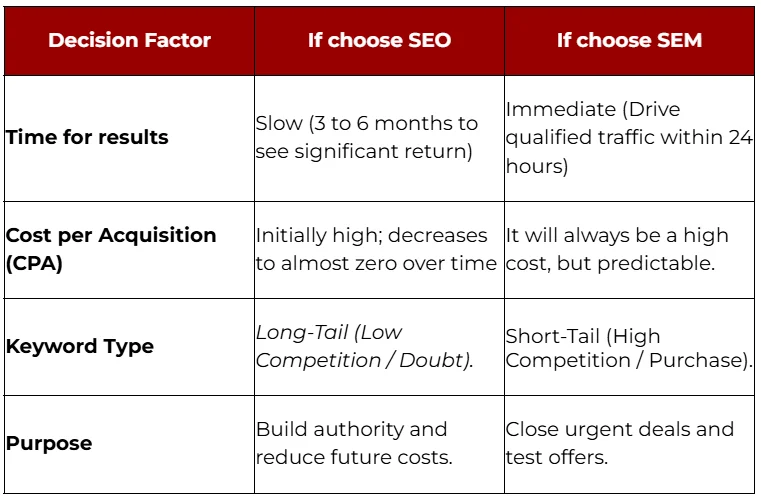
For a decision maker, the investment matrix boils down to time vs. cost. The answer to where to invest your first dollar in Google Positioning depends on your urgency.
Use SEM to capture existing demand and generate quick cash flow, while simultaneously investing in SEO to build assets that will reduce your dependence on advertising in the long term.
Conclusion
We have broken down investment in Google positioning into two critical areas: SEO as a long-term authority builder with long-tail keywords, and SEM as an immediate sales accelerator with high-intent terms. The key to profitability lies in strategic combination, not in choosing one tool exclusively.
Do you know if your current strategy is wasting money on clicks from leads that don’t convert?
With the GoRocket team, we will analyze your situation to show you the fastest and most efficient route to the first page.